
|
|
|
The Mystery Behind
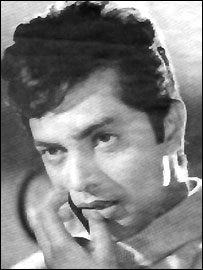
Waheed Murad
By Khurram Ali Shafique
Daily Dawn November 23, 2008 |

Waheed Murad
Films
Songs filmed:
Solos
Duets
Chorus
Listen to the songs
Today (23
Nov 08) is
the 25th death anniversary of this under-rated genius of our film
industry.
l have been researching the life and works of Waheed Murad for more than
20 years now and the mystery around him deepens with every new clue that
I come across.
He is the greatest screen legend of Pakistani cinema and therefore we
forget that he was also a writer, director and producer who entered
filmdom with the intention of making some serious statements about the
nation (he didn’t even appear on screen in his first two productions).
As soon as we shift our attention from the Chocolate Hero to the
film-maker, we are in for a volley of surprises. Here I discuss just one
of the many. |
 |
|
As an actor Waheed
Murad featured in more than 120 films but he also produced 11 titles
under his banner, Film Arts. The first two in which he didn’t appear may
rightly be regarded as pilot projects since he hadn’t even formed his
team by that time, and it can be presumed that the statement he was
trying to make didn’t come across effectively. That leaves nine films
which can be rightly considered as his “statements”. Quite surprisingly,
they seem to depict the gradual unfolding of a single profound message —
sometimes too bold to be given directly and hence necessitating the use
of masks and parables.
|
The
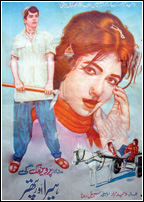
first is Heera Aur Patthar (1964), which was the story of two brothers
hailing from a working-class family on the outskirts of Karachi. One of
them gets educated in the city but in order to marry in a wealthy family
he disowns his ageing father, young brother and a sister of marriageable
age. In the next film Armaan (1966), which was also written by Waheed,
one saw just the opposite as here an educated young man (played by him)
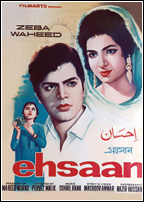
seeks his soul mate in a poor orphaned girl (Zeba). Ehsaan (1967)
presented the story of an orphaned boy raised by a benevolent family
falling in love with a young widow already the mother of a school-going
daughter.
I see a definite
pattern emerge here. If the torn-apart family in Heera Aur Patthar is
taken as an
analogy of Pakistani society then the message is
clear — the educated middle class has severed its organic
connection with the unschooled masses who are |
|
compelled to
drive the wheels of
the country all by themselves (the disowned brother is a donkey-cart
driver played by Waheed).
If this was indeed
the message that Waheed intended to impart through the film, then the
very next one suggests the solution: Educated youth from well-off
families should try to find out what their real ideal ought to be.
Ehsaan (1967) seems to present the basic principle on which societies
like Pakistan can be built. The principle is ehsaan which, roughly
translated, means ‘benevolence’ but has a deeper meaning in sufi
terminology and these meanings are successfully explored by the gifted
poet Masroor Anwar in the film’s songs and dialogue.
|
 |
 |
If Waheed was a
film-maker who presented the anatomy of Pakistani society through his
films then he couldn’t have remained indifferent to the rift between
West and East Pakistan which had begun to appear by that time. It became
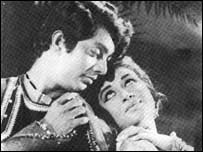
the theme of his next film which was symbolically named Samandar (1968),
since the sea and not the land connected the two wings of the then
Pakistan. For the female lead role he invited the Bengali actress
Shabnam from East Pakistan who had never worked in West Pakistan before.
The music was also composed by Deeboo Bhatachariya (instead of Waheed’s
usual composer Sohail Rana). The lyrics were penned by none other than
Sehba Akhtar who later became famous as the Poet of Pakistan for
patriotic numbers such as Main Bhi
Pakistan Hoon,
Tu Bhi Pakistan Hai.
In the lyrics for Samandar, he infused the some |
|
patriotism in layers of
allegory, such as the famous title song Saathi, Tera Mera Saathi Hai
Lehrata Samandar (O’ friend, the sea is our mutual friend).
Interestingly, the
story of Samandar (also written by Waheed himself) shifted the focus
from love interest to the strained friendship between two friends. Set
in a fishing colony which can be treated as an analogy of Pakistan, one
friend aspires for nothing except love while the other who aspires to
become the next leader of the fishing colony ends up playing in the
hands of
outsiders. The first friend (Waheed) is |
 |
|
persuaded by the people
to defeat the other in the race for leadership, but having done that he
transfers the power to his defeated friend after eliciting from him a
promise that he would serve the community without playing into hands of
the outsiders.
In those days
Samandar was not taken as anything but an ordinary film, but now it
seems almost certain that it was an analogy of the East Pakistan crisis:
Waheed was suggesting that the only moral ground for asking the East to
give up on the Six Points for the sake of the federation was that the
politicians of West Pakistan should agree in return to let the next
prime minister be from the East. It may be asked why Waheed didn’t
elaborate his message so that people could understand what he was trying
to say. This is a question which should answer itself. Those were the
days when Sheikh Mujibur Rehman was being tried for treason by a
military government and what Waheed was saying about the issue could
have landed him in jail and earned a permanent ban on his film.
Quite understandably, the next was Ishara (1969), literally meaning
‘hint’ or ‘suggestion’. It is the only film ever directed by Waheed (he
also wrote it) and turned out to be an allegory about the film-maker’s
creative self. The film opens with the subjective camera moving into an
alley, and Waheed’s voiceover telling us that this is the street where
he lives. Thus the camera becomes the eye of the viewer visiting the
inner world of Waheed’s creative self (he plays a painter whose
paintings are “admired by many but purchased by none”).
Quite interestingly, we see him entertaining three little children in
his studio. He asks their opinions about his newly finished painting,
and the opinions turn out to be very immature. Here is Waheed and his
audience then. He has got no option but to wait for the day when they
“grow up” but even while they are immature, his affection for them is
unfailing.
Naseeb Apna Apna (1969) takes this analogy into a darker zone by
portraying a sister who works as a dancing girl in the red light area in
order to “educate” her brother who lives in a hostel and is unaware of
the dark side of his family. Needless to say the dancing girl can be
taken as an analogy of the entertainment industry which is unfairly
treated as a mere plaything (a point which Waheed’s team of Pervez Malik,
Sohail Rana and Masroor Anwar were also trying to drive home in another
film called Doraha around the same time).
The East Pakistan crisis is revisited in Mastana Mahi (Punjabi), which
was released in early 1971. Sheikh Mujib had won the elections but the
politicians of West Pakistan as well as the army were reluctant in
transferring power to him. Failure of negotiation was followed by a
disastrous army action which resulted in the break up of the country.
The opening sequence of Mastana Mahi was about a village thug who
prevents a married woman from going to her husband belonging to another
village. In retrospect, allusions to the political situation are
extremely obvious throughout this sequence (such as the skin of a Bengal
Tiger displayed on the wall of the village thug although the tiger is
not found in Punjab), and the rest of the film places the question of
national integration in its larger perspective — and it is a perspective
which is relevant even today.
Waheed’s last two films, Jaal (1972) and Hero (1985), although separated
by 13 years (the last film was released more than a year after his
death), have the common theme of the agonies of a soul which knows too
much. Jaal’s poor taxi driver educates his sister and gets her married
into a well-to-do family. While raising money for that purpose he falls
into the trap of a crime racket which, he learns only at a later stage,
is being run by none other than the father-in-law of his newlywed
sister. For her sake he is willing to risk all but she risks her own
life in order to force him to speak the truth. Hence we see a complete
reversal of the Heera Aur Patthar situation as things come full circle
and for the better.
Waheed had claimed before the press that “A new Waheed Murad will appear
before you in Hero.” It is the story of a thief who is so perfect in his
craft that he leaves no trace behind (just as Waheed doesn’t leave any
clue of the underlying subversive messages in his films, and yet they
could not be more perfect in allegorical structure). This becomes his
Achilles’ heel because he gets caught every time the police don’t find
any evidence on the scene of the crime. His boss provides him cover by
setting up a fake film company and introduces an illiterate look alike
of the thief as a hero. The police mistake him for the thief and
maintains surveillance on his activities while the real thief goes about
his business — he now has an alibi.
Needless to say, the story was written by Waheed. This leaves us with a
nagging question about who the real Waheed Murad was — the one we
watched on screen as the Chocolate Hero or the genius who stayed behind
in the dark and played around with our emotions? In one of his last
interviews he had said, “Sometimes I think that if I suddenly disappear
or am no more for any reason, I would like to be remembered by the song
‘Bhooli hui hoon dastaan, guzra hua khayal hoon/ Jiss ko na tum samajh
sakay mien aisa aik sawal hoon’.” (I’m a tale forgotten, a though
bygone. I’m the question which you couldn’t understand).
Further information about his statement
films is available on
http://untoldwaheed.blogspot.com, which is a
non-commercial endeavour launched on the occasion of Waheed Murad’s 25th
death anniversary. |
| |
| |
| |
|
